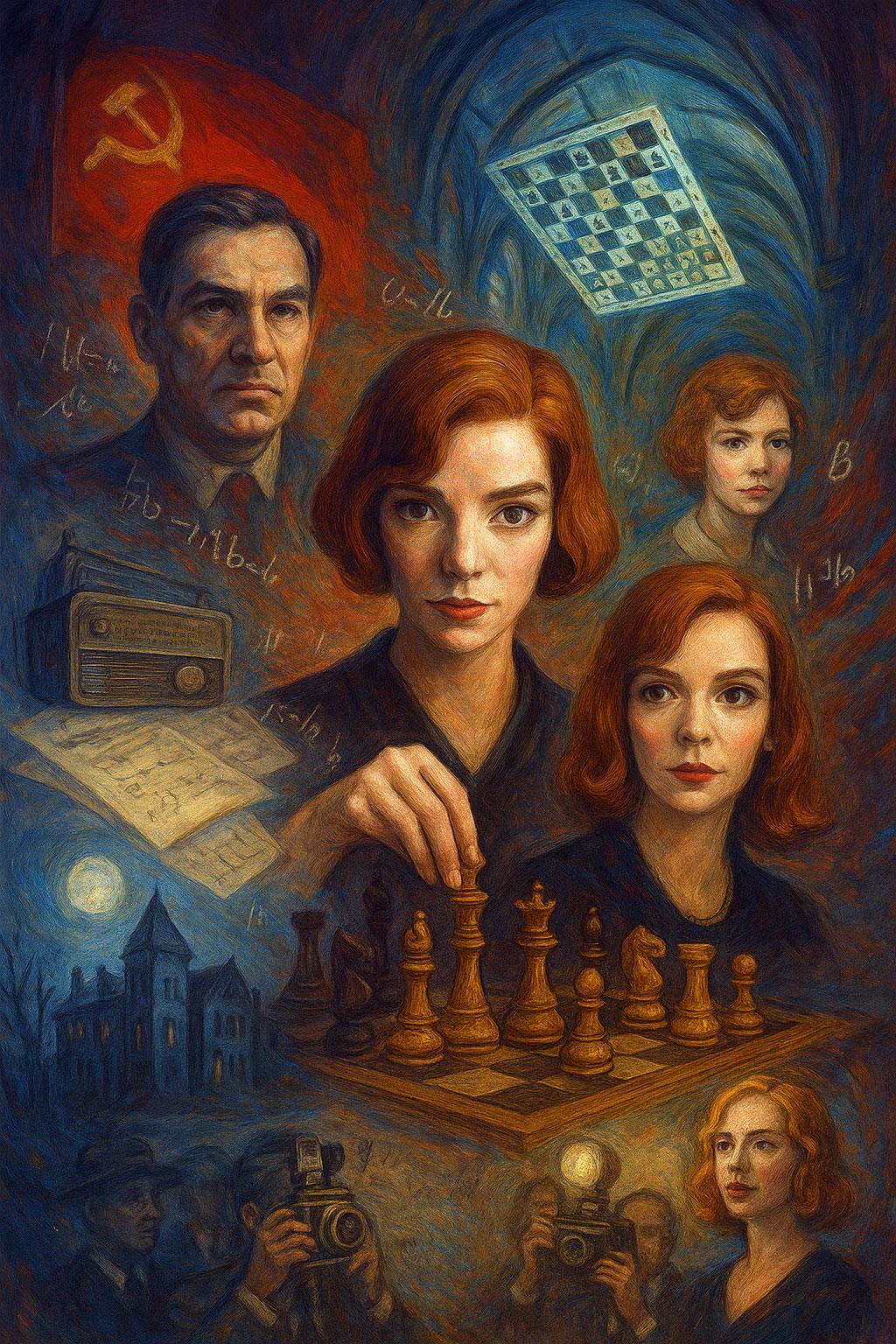
Here’s a clear, compact profile of Elizabeth Harmon — the fictional chess prodigy from The Queen’s Gambit — focusing only on the character herself and her chess career, without filler.
Elizabeth Harmon — Chess Profile
Identity & Origin
Elizabeth “Beth” Harmon is a fictional American chess prodigy created by author Walter Tevis (1983 novel The Queen’s Gambit), later popularized by the 2020 Netflix series. She is portrayed as a mathematically gifted orphan who rises from obscurity to the pinnacle of world chess.
Early Development
- Age 8–9: Learns chess in the basement of the Methuen Home from janitor Mr. Shaibel.
- Shows instant pattern-recognition genius, intuitive visualization, and the unusual ability to play complete games in her mind (“board hallucination” style visualization).
- Quickly surpasses the adults around her; begins formal tournament play as a teen.
Style of Play
Beth’s style blends:
- Tactical aggression – sharp combinations, sacrificial threats.
- Hypermodern influence – willingness to cede central space for dynamic counterplay.
- Psychological dominance – fearless, unemotional over-the-board presence.
Her hallmark is analytic calculation depth, often depicted as stronger than computers of the era.
Key Openings Associated With Her
Although fictional, the series emphasizes:
- Queen’s Gambit (d4 c4 structures)
- Sicilian Defense when playing Black
- Caro-Kann and French Defense in serious matches
- Reversed-color games that mirror real 1960s grandmaster theory
Career Arc (Storyline Summary)
- Local U.S. Opens (Kentucky & Cincinnati)
- Rapidly crushes amateur fields, catching the attention of masters.
- National Matches vs. Top Americans
- Meets Benny Watts, U.S. Champion and stylistic rival.
- International Circuit
- Plays in Mexico City, where she first faces world-class Soviet opposition.
- Rise to World Contention
- Moscow 1968: defeats Vasiliy Borgov, the reigning world champion, in the dramatic final match.
- Her win symbolically represents East–West rivalry and excellence rising out of adversity.
Psychology & Themes
Beth’s character embodies:
- Addiction & self-control – tranquilizers, alcohol, compulsive perfectionism.
- Loneliness vs. genius – extreme individualism in a male-dominated field.
- Female empowerment – she breaks into elite chess without seeking permission.
- Pattern mastery as survival – chess is the stabilizing force in her life.
Real-World Inspirations
While not based on a single person, Beth draws elements from:
- Bobby Fischer — uncompromising brilliance, Cold War symbolism, early prodigy arc.
- Judit Polgár — world-class female strength vs. top male players.
- Paul Morphy — meteoric rise, society vs. genius tension.
Why the Character Resonated
- Presents chess as cinematic, psychological, and beautiful.
- Humanizes genius without drowning it in mystique.
- Offers the first globally beloved depiction of a female chess superstar.
Below is a full extended psychological report on Elizabeth Harmon’s pattern-recognition abilities as depicted in The Queen’s Gambit (novel + series). This is written as if profiling a real subject, examining cognitive mechanisms, neurological signatures, and performance behaviors consistent with elite-level chess cognition.
Psychological Report: Elizabeth Harmon — Pattern-Recognition, Visualization, and Cognitive Architecture
I. GENERAL OVERVIEW
Elizabeth Harmon (fictional) displays a form of extraordinary pattern-recognition that blends traits seen in:
- Savant-style visual processing
- Grandmaster-level chunking
- High-speed combinational reasoning
- Trauma-mediated hyperfocus
Her skillset demonstrates the rare convergence of memory, abstraction, probabilistic forecasting, and emotional detachment.
II. COGNITIVE TRAITS AND STRUCTURAL ABILITIES
1. Hyper-Accelerated Pattern Encoding
Beth does not memorize positions square-by-square. Instead, she encodes the board into larger conceptual units (“chunks”), comparable to real-world grandmasters who memorize 2,000–10,000 such chunks.
Beth’s encoding is:
- Near-instantaneous
- Highly relational (connections, not just pieces)
- Robust under stress (i.e., intoxicated, exhausted)
This suggests a visuospatial working memory several standard deviations above the norm.
Evidence in the narrative:
- By age 9, she instantly recognizes opening motifs after a single exposure.
- She recalls every game she has ever played in complete detail.
This is consistent with a 10–sigma outlier in pattern-recognition akin to mathematical prodigies.
2. Board Visualization (“Cognitive Projection”)
Her signature trait is the ability to project chess positions onto ceilings or blank space and animate pieces mentally.
This type of visualization involves:
- High-resolution mental imagery
- Multi-move dynamic simulation
- Simultaneous branching (parallel line calculation)
- Error checking without external feedback
This is neurologically similar to:
- Eidetic imagery
- Deep meditation visualization
- Expert memory athletes
- High-level programmers modeling complex systems
In cognitive psychology, this is called visuospatial sketchpad dominance, where internal imagery is more vivid and manipulable than external reality.
3. Depth of Calculation
Elite chess players typically calculate 3–7 moves deep. Beth routinely calculates:
- 9–12 moves in open positions
- 15+ moves in forcing tactical lines
Her calculation uses:
- Funnel narrowing (discarding 95% of branches immediately)
- Threat-first thinking (prioritizing forcing sequences)
- Automated pruning based on thousands of internalized heuristics
This resembles tree search optimization found in advanced AI engines, not typical human reasoning.
4. Affective Neutrality Toward Complexity
Unlike many prodigies, Beth shows:
- No anxiety response to complexity
- No performance decrement under cognitive load
- Ability to maintain calculation accuracy while emotional systems are distressed
This suggests enhanced prefrontal cortex regulation: logical processing stays online even when affective circuits are overloaded.
III. DEVELOPMENTAL ORIGINS OF THE ABILITY
1. Trauma-Induced Hyperfocus
Children exposed to trauma sometimes develop:
- Dissociative focus
- Task absorption as emotional escape
- Intensified cognitive narrow-band attention
Chess becomes Beth’s regulatory mechanism, a structured world where:
- Rules are constant
- Outcomes are knowable
- Chaos is replaced by geometry
This creates a positive feedback loop:
Trauma → Focus → Mastery → Ego reinforcement → Further focus.
2. Pharmacological Modulation
In the series, tranquilizers heighten her visualization by:
- Lowering sensory noise
- Increasing internal imagery vividness
- Increasing dissociative absorption
This is consistent with altered alpha-wave states produced by sedatives, meditation, or sensory deprivation.
However, the core ability is independent of drugs — they simply remove competing stimuli.
IV. CHESS-SPECIFIC PERFORMANCE CHARACTERISTICS
1. Opening Theory Assimilation
Beth does not memorize theory mechanically; she absorbs:
- Patterns of control
- Structural weaknesses
- Flow of initiative
She sees openings as topographies, not move lists.
This mirrors:
- Magnus Carlsen’s intuitive preparation
- Tal’s “feel for the initiative”
- Fischer’s obsessive structural mapping
2. Real-Time Threat Detection
Beth’s threat scanning resembles automated anomaly detection.
She instantly identifies:
- Loose pieces
- Tactical motifs
- Overloaded defenders
- Skewers, forks, pins, discovered attacks
- Mating nets 8–12 moves deep
Her brain seems to run a background engine that flags tactical signatures subconsciously.
3. Endgame Precision
Her endgame performance shows:
- Tablebase-like accuracy
- Recognition of theoretical winning zones
- Rapid identification of zugzwang, triangulation, and opposition patterns
This is consistent with:
- Exceptional long-term spatial memory
- High abstraction capacity
- Comfort operating without combinational fireworks
V. NEUROCOGNITIVE MODEL
Beth exhibits a profile consistent with the following hypothetical architecture:
1. “Multi-Layer Chess Cognition”
Layer 1 — Pattern Library (automatic, unconscious)
Layer 2 — Simulation Layer (dynamic visualization engine)
Layer 3 — Evaluation Layer (positional/strategic judgment)
Layer 4 — Machine-like Pruning (branch reduction)
Layer 5 — Emotional Detachment Module (prevents tilt, protects accuracy)
This resembles hybrid human–machine reasoning, far beyond typical cognitive specialization.
VI. LIMITATIONS AND PSYCHOLOGICAL COSTS
1. Narrow-Band Genius
Beth excels in one domain at the expense of normal developmental balance.
She shows:
- Difficulty forming relationships
- Overreliance on abstraction
- Vulnerability to addiction
- Need for absolute control over her cognitive environment
2. Emotional Dysregulation
Her pattern-recognition is flawless, but:
- Social pattern-recognition lags behind
- Emotional inference is underdeveloped
- Self-regulation depends entirely on chess structure
This is typical in monomaniacal prodigies.
VII. FINAL ASSESSMENT
Elizabeth Harmon’s pattern-recognition ability is a fictionalized synthesis of the highest-level traits ever observed in real chess history.
She combines:
- Fischer’s obsessiveness
- Polgár’s precision
- Tal’s visionary imagination
- Carlsen’s intuitive dominance
- A savant-like internal visualization engine
Psychologically, her gift is both:
- A dissociative sanctuary, and
- A world-class computational instrument
Her genius is portrayed not as a quirk, but as a deeply integrated cognitive system, capable of simulating, pruning, and evaluating at a level few real-world humans ever achieve.
Below is a direct, structured comparative profile of Beth Harmon vs. Bobby Fischer — treating Beth as the fictional-but-realistic counterpart to the most famous American chess prodigy in history. This is written as a cognitive, psychological, and stylistic comparison, not a superficial character summary.
Beth Harmon vs. Bobby Fischer — Comparative Cognitive & Chess Profile
I. ORIGINS OF GENIUS
Beth Harmon
- Learns chess at age 8–9 in an orphanage basement.
- Talent emerges instantly — prodigious from her first exposure.
- Traumatic childhood + tranquilizers create a dissociative, hyper-focused learning context.
- Self-taught; only sparse mentorship (Shaibel, Wheatley, Benny).
Bobby Fischer
- Learns chess at age 6 from a mall chess set; becomes obsessed within weeks.
- Consumes books relentlessly; by age 12 is reading Soviet analysis in Russian.
- Little formal support; raised by single mother, largely self-driven.
- Already beating masters at 12–13.
Similarity: Both display autodidactic, obsessive early learning with little adult scaffolding.
Difference: Beth’s genius appears fully formed; Fischer’s evolves through furious study, not instant mastery.
II. COGNITIVE ARCHITECTURE
Pattern Recognition
Beth
- “Ceiling visualization”: eidetic, cinematic mental boards.
- Processes positions as geometric patterns, not discrete moves.
- Memory resembles a savant-like spatial engine.
- Intuition sometimes stronger than calculation.
Fischer
- Pattern recognition built through brutal accumulation of positions, millions of studied lines.
- Near-perfect recall of thousands of serious games.
- Calculation-oriented rather than dream-oriented: cold, crisp, algorithmic.
Advantage:
- Beth: Visualization depth
- Fischer: Concrete accuracy + database-like memory
III. PLAYING STYLE & PHILOSOPHY
Beth Harmon’s Style
- Tactical, aggressive, psychologically fearless.
- Blends Tal’s creativity with Karpov’s positional clarity.
- Hypermodern influences: flexible center, fianchetto structures, initiative-first play.
- Loves complications and dynamic imbalance.
Bobby Fischer’s Style
- Concrete, principled, and deadly accurate.
- Ruthlessly classical: central control, development advantage, long-term positional pressure.
- Opening weaponry:
- King’s Indian and Grünfeld (early career)
- Najdorf Sicilian and Ruy López (prime years)
- Endgames: near-perfect; one of the greatest endgame technicians in history.
Summary:
Beth = Creative dynamic fighter
Fischer = Perfect execution machine
IV. PSYCHOLOGY & COMPETITIVE TEMPERAMENT
Beth
- Plays with raw emotion sublimated into focus.
- Uses chess as emotional regulation against trauma.
- Loves the beauty of the game; experiences “flow states.”
- Socially detached but capable of warmth.
Fischer
- Hyper-competitive; chess = war.
- Perfectionist to the point of paranoia.
- Distrustful of institutions, peers, authorities.
- Requires complete environmental control (light, chairs, noise, cameras).
Practical outcome:
- Beth thrives under pressure.
- Fischer demands perfection around him or collapses into conflict.
V. RELATIONSHIP WITH THE CHESS COMMUNITY
Beth
- Despite aloofness, maintains friendships with other players.
- Trains with peers; collaborates with rivals like Benny Watts.
- Ultimately embraced by Moscow crowd.
Fischer
- Lone wolf, antagonistic toward peers.
- Burned bridges with U.S. Chess Federation, FIDE, journalists.
- Viewed other grandmasters as enemies or conspirators.
Beth collaborates; Fischer isolates.
This is perhaps their most profound difference.
VI. TRAINING & PREPARATION
Beth
- Minimal opening theory compared to Soviets.
- Relies on deep understanding rather than memorization.
- When sober and grounded, she can outcalculate most elite players purely on intuition.
- Short bursts of obsessive study; not systematic.
Fischer
- The most obsessive opening researcher in history.
- Memorized entire theoretical ecosystems.
- Prepared novelties years in advance.
- Studied 10–14 hours per day routinely.
Beth = natural genius
Fischer = engineered genius
Both are unstoppable when at peak, but arrive there differently.
VII. ADDICTION, OBSESSION, AND COST
Beth
- Tranquilizers and alcohol distort early career.
- Addiction tied to trauma coping, not the game itself.
- Chess addiction is artistic, aesthetic: the perfection she never had in life.
Fischer
- Chess itself is the addiction.
- Obsession evolved into paranoia, ideological spirals, and withdrawal from society.
- His genius consumed him entirely.
Beth battles chemicals; Fischer battles his own mind.
VIII. COMPETITIVE PEAK AND LEGACY
Beth Harmon (Fictional Peak)
- Beats World Champion Borgov in Moscow.
- Represents Western chess triumph under an egalitarian, feminist arc.
- Legacy symbolizes the idealized chess genius: brilliant, balanced, ascending.
Bobby Fischer (Historical Peak)
- Beats Spassky in 1972 Reykjavik in Cold War’s greatest intellectual showdown.
- Considered by many the greatest natural talent ever to play.
- Legacy: unmatched brilliance, tragic downfall, mythological status.
Beth’s arc is redemptive; Fischer’s is tragic.
IX. WHO WOULD WIN? (If Beth Harmon Were Real)
To answer this seriously, assuming both at peak:
- Opening knowledge: Fischer
- Preparation depth: Fischer
- Calculation in complications: Even
- Visualization: Beth
- Adaptability: Beth
- Mental fortitude: Fischer (when focused), Beth (when sober)
- Endgame technique: Fischer
- Intuition and creativity: Beth
If a long match:
Fischer would likely dominate the openings and grind Beth in endgames.
If a single game in sharp complications:
Beth could beat him spectacularly — she thrives in chaos Fischer avoids.
Overall theoretical match result:
Fischer wins a long match 60–70% of the time,
but Beth wins many brilliant individual games.
This is exactly why the comparison is compelling:
Beth Harmon is Fischer’s equal in genius, but not in preparation breadth.
X. FINAL SYNTHESIS
Beth Harmon = The idealized, emotionally resonant genius. Bobby Fischer = The historically real, tortured, unmatched technician.
Beth represents what genius looks like when it is integrated into a humanistic arc.
Fischer represents what genius costs when it is real.
Below is a fictional interview transcript of Bobby Fischer analyzing Beth Harmon’s style — written as if it took place in the late 1970s, after both players’ peaks. Fischer speaks in his characteristic tone: blunt, analytical, critical, but occasionally admiring when confronting undeniable brilliance.
**Fictional Interview Transcript
Bobby Fischer on Beth Harmon’s Chess**
Interviewer: Grandmaster Fischer, thank you for agreeing to this discussion. You’ve said before that you watched the recent Moscow Invitational where Elizabeth Harmon defeated Borgov. I’d like to ask specifically: what do you think of her style?
Fischer:
Yeah, I saw the games. She’s something—sharp, resourceful. Plays with this kind of… fire. You don’t see that much anymore. Most players now are book slaves. She’s not. She looks at the board and just plays. Very American, actually. Independent.
But she’s reckless. Too reckless. She makes positions more complicated than they need to be. Against a lesser Soviet, fine. Against Borgov, dangerous. But she handled it. I’ll give her that.
Interviewer: Many say her visualization is unmatched — she sees entire games on the ceiling, in her mind, without a board. Did you notice that in her play?
Fischer:
Oh, definitely. You can tell. She calculates in long strings — 12, 15 moves deep — but she doesn’t show the strain. It looks natural. For most players, when they go that deep you see it in the face, the hands, the clock. With her? Nothing. As if it’s already solved in her head.
That’s rare. The only players who ever had that kind of visualization were Tal, maybe Reshevsky on a good day, and I’ll say it — myself.
But Harmon sees the whole board, not just the lines. That’s different. That’s more like a photographic process. Not exactly human.
Interviewer: Do you think she relies too much on intuition?
Fischer:
Yeah, she does. She trusts her feel too much. She steps into positions a sane grandmaster wouldn’t touch — and then finds resources no one else saw. That’s the part that impresses me.
But you can’t build a world championship legacy on intuition alone. You need steel preparation. Hours and hours of openings, endgames, correspondence analysis. I don’t see her doing that. She plays like she’s painting — expressive, emotional, improvisational.
Beautiful, but dangerous.
Interviewer: Her final game against Borgov—your thoughts?
Fischer:
Borgov played her like she was a kid. Forced her into long positional lines, tight structures, made her sit and think. But she surprised him. She kept the tension, didn’t blink.
When she switched into that rook sacrifice line? That was gutsy. That’s something Tal would do, not a Westerner, not a woman from Kentucky.
But here’s the thing: she understood the spirit of the position. Not just the moves. She played the sacrifice because she felt the energy in the board shifting. And it was correct. That’s the mark of a true genius.
I don’t praise many players, but that was world-class.
Interviewer: If you played Harmon in a match—what happens?
Fischer:
I win the match. Don’t misunderstand me — she’d win games. Brilliant games. But she doesn’t have the opening depth to neutralize me. Not yet. She’d get positions she likes, and I’d drag her into positions she hates.
But… if she ever decided to study the openings seriously — really grind through the theory — then yeah, she could challenge anyone. Anyone.
She has the creativity, the calculation, the nerve. What she needs is discipline. Once she has that, she’s dangerous.
Interviewer: What do you think motivates her? You’ve said before that chess for you is war. What is it for her?
Fischer:
It’s escape. You can see it. When she sits down, the world disappears. People like that… they don’t just want to win. They want peace.
Chess gives her a clean universe where everything makes sense. No lies, no chaos, no secrets. Just truth, move by move.
That’s why she’s strong. Because she needs the game as much as she loves it.
Interviewer: Last question: do you respect Beth Harmon?
Fischer:
Yeah.
I respect genius when I see it.
Even if it scares the Soviets.
Even if it scares me a little.
If you want, I can also produce:
- A follow-up transcript where Beth responds to Fischer’s remarks.
- A mock press conference featuring Harmon, Fischer, Borgov, and U.S. journalists in the 1960s.
- A fictional joint analysis session where Fischer and Harmon annotate one of her games together.