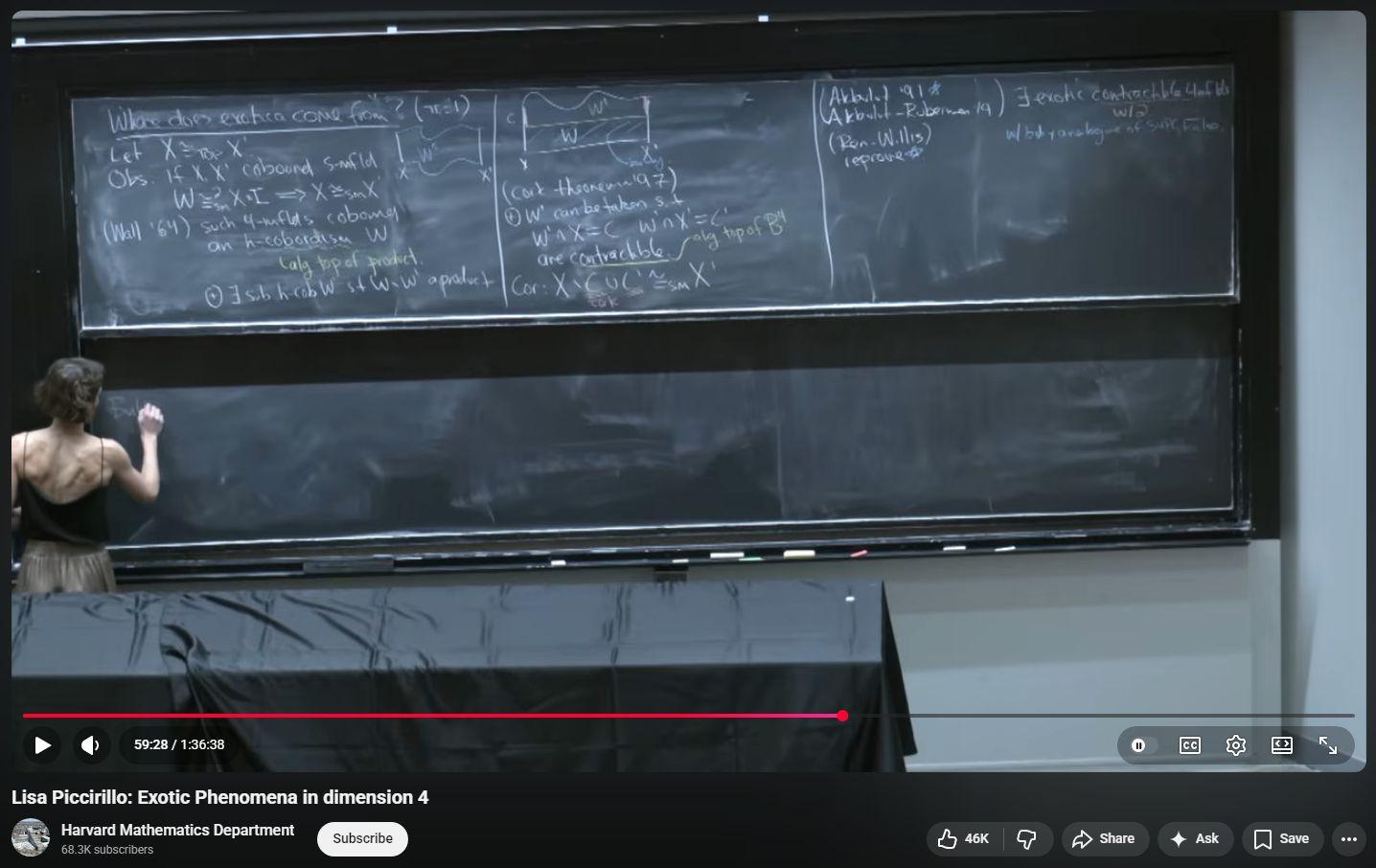
Imagine geometry, but on steroids. Here is the ultimate, jargon-free summary of Lisa Piccirillo’s talk for absolute beginners:
1. The Core Concept: What is a Manifold?
A manifold is any shape that looks complicated from far away, but looks completely flat and normal if you zoom in really close.
– The Classic Example: The Earth. From outer space, it is a round 3D ball. But to you standing on the sidewalk, the ground looks like a flat 2D plane. Because it looks flat up close, the surface of the Earth is a 2D manifold.
2. The Twist: Topological vs. Smooth
In mathematics, you can look at these shapes through two different lenses:
– Topological (The Rubber Sheet Rule): You treat the shape like playdough or rubber. You can bend, stretch, and twist it however you want, as long as you don’t tear it or glue parts together.
– Smooth (The Calculus Rule): You are much stricter. The shape must be perfectly smooth with *absolutely no sharp corners, spikes, or creases*. This allows you to do physics and calculus on the shape.
3. The Mystery of the 4th Dimension
Mathematicians have successfully classified these shapes in the 1st, 2nd, and 3rd dimensions. They even figured out the 5th dimension and higher using algebra.
But the 4th dimension is a chaotic black hole. While the “playdough” (topological) shapes are understood , the “smooth” shapes are an absolute mystery.
This brings us to the main character of the talk: *Exotic Manifolds*. These are pairs of 4D shapes that are completely identical when you treat them like playdough, but when you look at them through the strict “smooth” lens, *they are fundamentally different and can never be transformed into one another*.
4. Lisa’s Work:
Finding the “Glitch” How do you tell two identical-looking 4D shapes apart, or find where this pürüzsüzlük (smoothness) difference lives?
– The Cork Theorem: Scientists proved a mind-blowing rule: if you have two of these twin exotic shapes, the “glitch” that makes their smooth structures different doesn’t float around the whole shape. Instead, it is cleanly packed into one tiny, microscopic sub-piece called a *”Cork” (Mantar)*. If you cut this cork out, flip it, and glue it back in, you magically transform one shape into its exotic twin.
– The New Tool: Lisa Piccirillo and her colleagues developed a brand-new mathematical tool (called the α invariant). Think of it like a specialized metal detector. While older detectors would pass over these 4D shapes and beep identically (failing to see a difference), her new detector successfully rings a different note, proving once and for all that the smooth structures are distinct.
What really amazes me is that some people (her parents and teachers) must have (I hope) recognized her talent at a young age, nurtured it, encouraged her to be where she is today. When you think about it a little more, you will realize that many, many brilliant people are either born in poverty or die before they can achieve anything significant. But not her. She is unmistakably one of the most brilliant minds in math in the country right now (do check her wikipedia page).
Compare to Prof Janik’s presentation in Robert Redford’s 1992 movie SNEAKERS
I subscribed because I find it fascinating that I’m listening to my native language and a foreign language simultaneously.
Some people live in an intellectual stratosphere.
I looked up her dissertation, which begins: “Knot traces are elementary 4-manifolds built by attaching a single 2-handle to the 4-ball; these are the canonical examples 4-manifolds with nontrivial middle dimensional homology. In this thesis, we give a flexible technique for constructing pairs of distinct knots with diffeomorphic traces. Using this construction, we show that there are knot traces where the minimal genus smooth surface generating homology is not the canonical surface, resolving a question on the 1978 Kirby problem list. We also use knot traces to give a new technique for showing a knot does not bound a smooth disk in the 4-ball, and we show that the Conway knot does not bound a smooth disk in the 4-ball. This resolves a question from the 1960s, completes the classification of slice knots under 13 crossings, and gives the first example of a non-slice knot which is both topologically slice and a positive mutant of a slice knot.” I stopped there, went outside, and, like an early hominid, gazed up in wonder at the luminous moon.
I think I have the same facial expression watching this as my dog when I’m talking to him.
just learned that this lady gained significant recognition for solving a longstanding problem concerning the Conway knot, a complex structure in knot theory. In 2018, as a graduate student, she demonstrated that the Conway knot is not “slice,” resolving a question that had puzzled mathematicians for over 50 years. Congratulations
her work on the Conway knot proves how outdated ideas about 4D shapes don’t hold up when you actually dig deeper. She showed that what looks the same on the surface can be completely different inside by using clever math tricks—like finding a “hidden knot” to tell shapes apart. It’s just like how our framework shows that rigid theories don’t fit the messy, dynamic systems we deal with, and we need smarter, layered approaches to really understand what’s going on.
Dumb down Summary:
1. In the flat, 2D world of a piece of paper, we can easily understand different shapes, like circles and squares. But in the 3D world we live in, shapes get much more complicated.
2. Mathematicians are really interested in understanding 4-dimensional shapes, which are even harder to picture. They want to know if there are different types of 4D shapes that look the same on the outside, but are actually different on the inside.
3. Mathematicians have come up with a few different ways to study 4D shapes. They can try to build different 4D shapes and then figure out how to tell them apart. They also use special math tricks called “invariants” to help identify differences between shapes.
4. Over the years, mathematicians have gone through a few different periods of studying 4D shapes. In each period, they’ve gotten better at both making new 4D shapes and finding new ways to tell them apart.
5. Recently, mathematicians have started using some new, clever tricks to study 4D shapes. They’re finding new ways to construct 4D shapes, and they’re also finding new “invariants” that can help them figure out if two 4D shapes are really the same or different.
6. One of these new tricks is called the “slic approach.” It involves finding a special loop or knot in one 4D shape that doesn’t exist in another 4D shape. This can show that the two shapes are different, even if they look the same on the outside.
7. Mathematicians are also using computers to help them find new 4D shapes that might be different. They’re making lots of different 4D shapes and then using machine learning to try to figure out if any of them are really different on the inside.
8. One really cool idea is that the differences between 4D shapes can be hidden in a tiny, simple part of the shape. Mathematicians call this part a “cork,” and they’ve shown that this cork is the key to understanding how 4D shapes can be different.
9. Using this idea of the “cork,” mathematicians have been able to make some of the simplest possible examples of 4D shapes that are actually different on the inside, even though they look the same on the outside.
10. By understanding these simple, “corky” 4D shapes, mathematicians are hoping to get a better idea of where all the different types of 4D shapes come from, and how they’re related to each other. It’s like solving a big puzzle, one piece at a time!
Example – The amplituhedron.
It’s a mind-blowing multi dimensional geometric shape that simplifies particle physics. Instead of using Feynman diagrams to calculate particle interactions, you can just study this shape, which encodes all the info you need. What’s crazy is it works without space or time! It suggests that space-time might not be fundamental, but instead something that emerges from deeper geometric rules. Think of it as a cheat code for the universe: a single shape that predicts particle behavior.
I think explanation of any explanation is warranted. This seems really important, but it’s so nebulous… It reminds me of the esoteric / Enochian talks given on John Dee by Dan Winter and Vincent Bridges in Prague. And also the research of Stan Tenen / Meru Foundation which notes that ‘language is a dance’ by exposing how an anthromorphic complex shape (a metal band twisted in-palm among fingers and thumb) held in candlelight at various position exposes in shadow every letter-shape in the Hebrew alpabet. Cymatics is also surely conjured and involved.
https://www.youtube.com/results?search_query=dan+winter%2C+vincent+bridge%2C+enochian
Thank the Wide Wonders for females like her